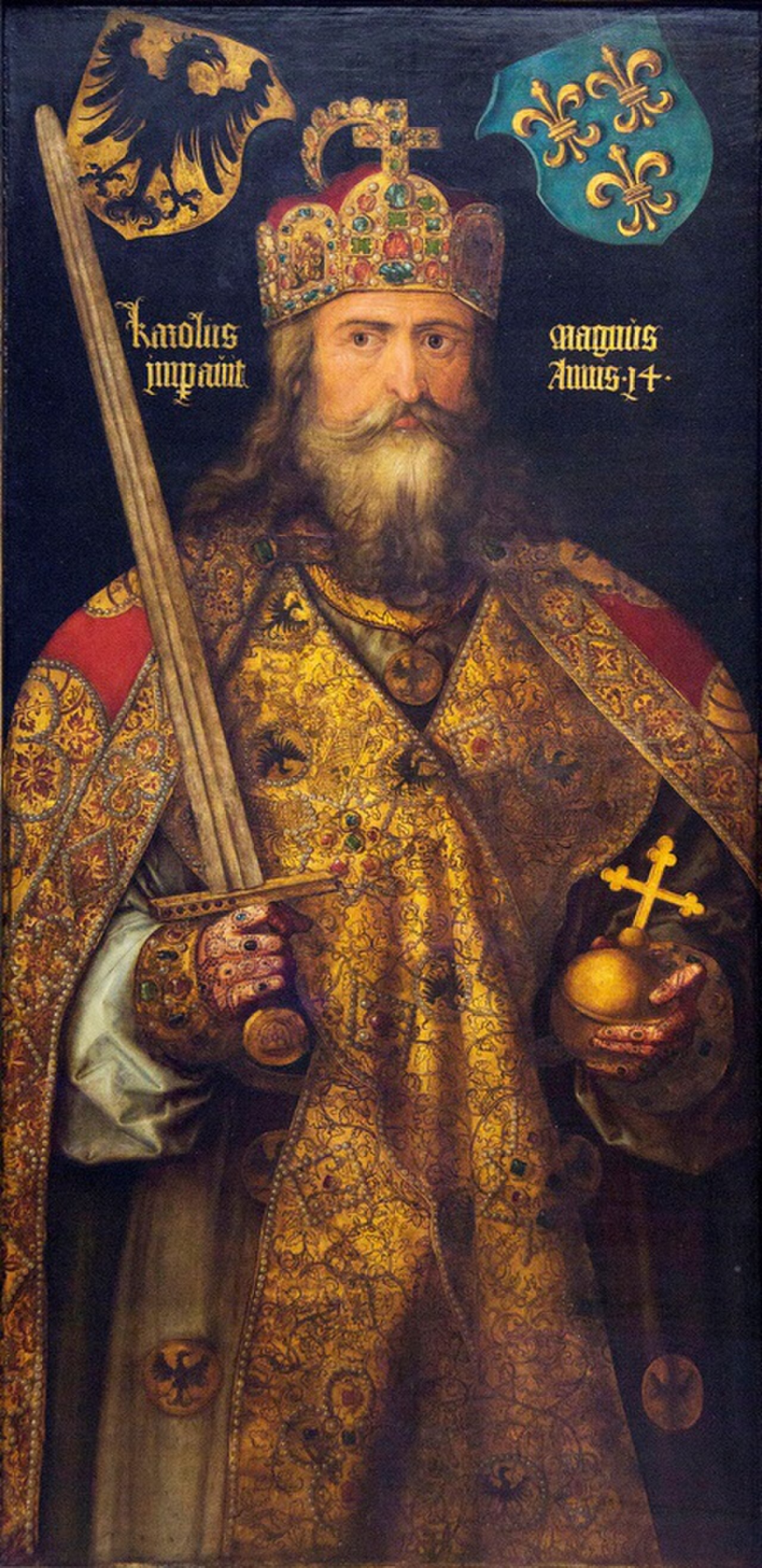
Charlemagne and Roland: what happened at Roncevaux, and what the song made of it
14 min read
Coronation of Pepin the Short at Saint-Denis on 28 July 754; Charles king in 768; Spanish expedition and ambush by the Vascones in the Pyrenees on 15 August 778; foundation of Aniane (c. 782), Charroux (c. 785), Saint-Riquier (790-799), Gellone (804), Germigny (806); imperial coronation in Rome at Christmas 800; death at Aachen on 28 January 814; Treaty of Verdun in 843; Song of Roland c. 1100; Pseudo-Turpin and hospital of Roncevaux c. 1127-1140; canonisation of Charlemagne by the antipope Paschal III on 29 December 1165
On 15 August 778, in a pass of the Pyrenees, Basque highlanders destroy the rearguard of the army Charlemagne is bringing back from a failed expedition against Zaragoza; Einhard names three dead, among them “Roland, prefect of the Breton march”. Three centuries later the Song of Roland has made of it the greatest story of the West, with its Saracens, its traitor, its olifant and its sword Durandal, and the pilgrims to Compostela have fixed it to the ground, from Roncevaux to Blaye. The route follows two threads that do not overlap: the real Carolingian places, from Saint-Denis to Aachen, from Germigny to Gellone and Conques, and the places of the legend, from the Ibañeta pass to Roland's Breach, Rocamadour and the Saut-Roland.
The son of Pepin
On Sunday 28 July 754, in the abbey church of Saint-Denis, Pope Stephen II, who had come from Rome to ask the Franks for help against the Lombards, anointed Pepin the Short, already elected king at Soissons three years earlier, and with him his two sons, Charles and Carloman, whom he made patricians of the Romans. Charles was about twelve, if 742 is taken as the year of his birth. Saint-Denis would remain the family's house: Pepin died there on 24 September 768 and was buried beneath the porch; Abbot Fulrad's new church was consecrated there on 24 February 775 in the presence of Charles, proclaimed king at Noyon on 9 October 768 and sole master since the death of Carloman in 771.

The rest with the History & Architecture key
You have just read the opening. The whole story, its timeline, its sources and its places on the map are in the application.
Read in the applicationThe places of this story
- Basilique cathédrale de Saint-DenisCathedral · Saint-Denis · Seine-Saint-Denis
- Abbatiale de Saint-RiquierChurch · Saint-Riquier · Somme
- Chapelle palatine d'Aix-la-Chapelle, tombeau de CharlemagneCathedral · Aix-la-Chapelle (Aachen) · Rhénanie-du-Nord-Westphalie (Allemagne)
- Cathédrale Notre-Dame de VerdunCathedral · Verdun · Meuse
- Oratoire carolingien de Germigny-des-PrésChurch · Germigny-des-Prés · Loiret
- Les roches du Saut-RolandRock / boulder field · Luitré-Dompierre (Dompierre-du-Chemin) · Ille-et-Vilaine
- Abbatiale carolingienne de Saint-Philbert-de-Grand-LieuChurch · Saint-Philbert-de-Grand-Lieu · Loire-Atlantique
- Abbaye Saint-Sauveur de CharrouxMonastery / hospice · Charroux · Vienne
- Citadelle de BlayeLegendary castle · Blaye · Gironde
- Basilique Saint-Seurin de BordeauxChurch · Bordeaux · Gironde
- Chapelle d'Ibañeta et monolithe de RolandChapel · Roncesvalles · Navarre (Espagne)
- Collégiale royale de Roncevaux (Real Colegiata de Roncesvalles)Church · Roncevaux (Roncesvalles/Orreaga) · Navarre (Espagne)
- Cathédrale Santa María la Real de PampeluneCathedral · Pampelune · Navarre (Espagne)
- Brèche de RolandSacred mountain · Gavarnie-Gèdre · Hautes-Pyrénées
- Sanctuaire de RocamadourChapel · Rocamadour · Lot
- Basilique Sainte-Foy de ConquesChurch · Conques-en-Rouergue · Aveyron
- Ancienne abbaye d'Aniane, la maison de saint Benoît d'AnianeMonastery / hospice · Aniane · Hérault
- Abbaye de Gellone et Pont du DiableMonastery / hospice · Saint-Guilhem-le-Désert · Hérault
Read next
 The Ways of St James: from the tomb in Galicia to the four routes of FranceAround 820-830, a bishop in Galicia recognises in a Roman tomb that of the apostle James, and a pilgrimage is born which, from the 10th to…
 The Normans: from Rollo to William the Conqueror (911-1087)In 911, a Carolingian king at the end of his resources grants a Viking chief, Rollo, "a land running from the Epte to the sea": in three…
 The Black Madonnas: Romanesque majesties, revolutionary pyres and the mystery of the colourFrom the Velay to the Beauce, from Cerdagne to Marseille, sixteen sanctuaries where a Virgin in Majesty with a black face is venerated…